Why Small Businesses Need a Website Besides Social Media (2025 Data)
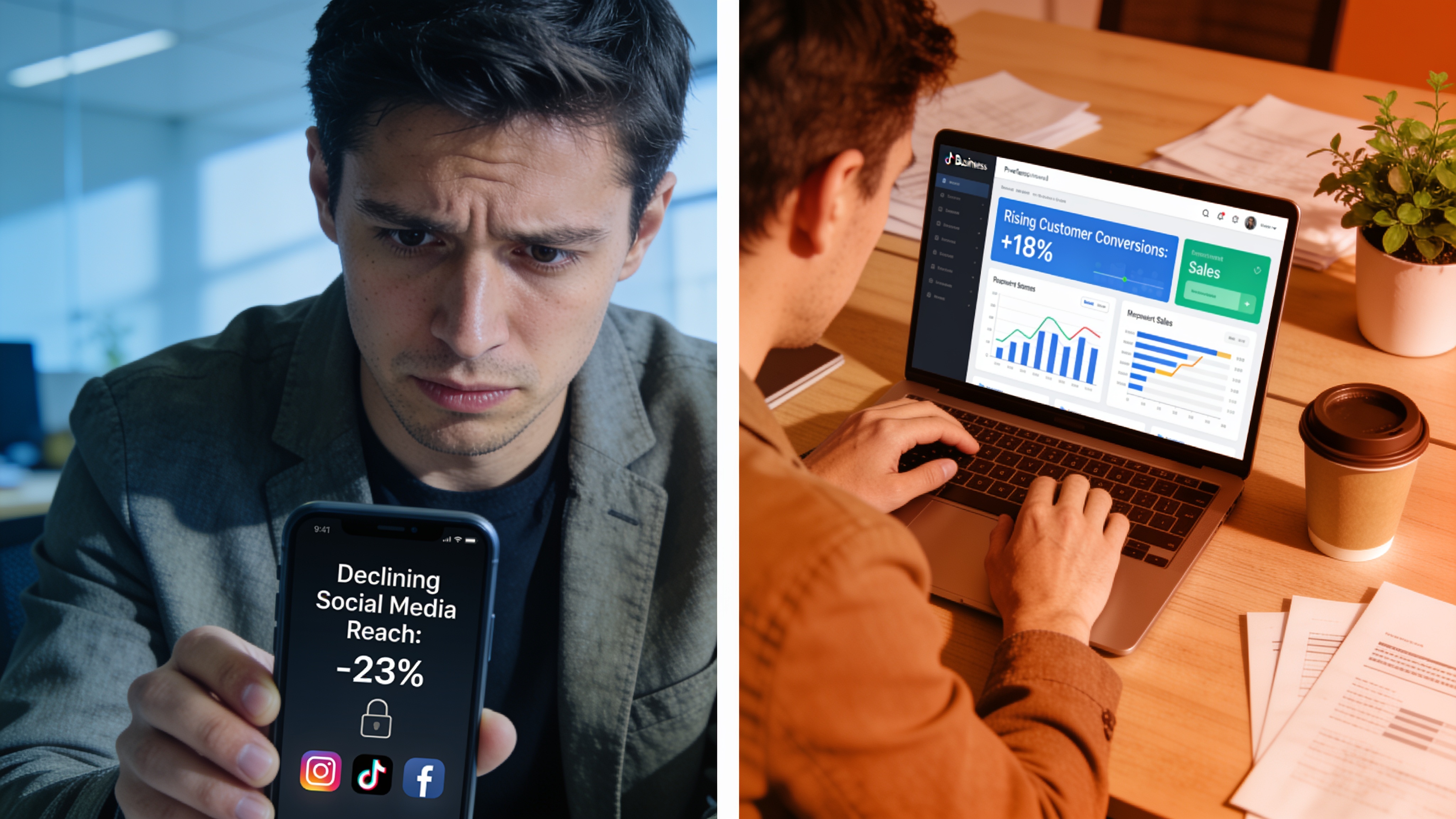
Why Small Businesses Need a Website Besides Social Media (2025 Data)
If your small business relies entirely on Instagram or Facebook to attract customers, you're not alone. But that dependency is riskier than ever. That's exactly why small businesses need a website besides social media in 2025: a website gives you control over your brand, builds instant trust, and converts visitors far more effectively than any social feed ever will.
Right now, social platforms are designed to keep people inside their apps, not send them to your shop. And while you're busy chasing likes, your competitors with a website are quietly turning clicks into customers.
The Organic Reach That Social Media Promised (and Lost)
Just a few years ago, a Facebook post could reach 16% of your followers without spending a dime. Today, organic reach has cratered. A 2025 analysis by social media analytics platform Socialinsider puts Facebook's average organic reach at just 1.37% to 2% for business pages. Instagram's organic reach dropped 12% year-over-year, and LinkedIn's fell a staggering 34%. These aren't temporary dips; they're the new normal as platforms push brands toward paid ads.
Meanwhile, algorithms now reward “engagement signals” like comments and saves far more than likes. Instagram itself confirmed that comments and saves can carry up to 200% more weight than a simple double-tap. On top of that, posts containing external links are deprioritized because the platforms would rather you stay on their turf.
For the small business owner posting daily and seeing nothing but a handful of likes, this can feel bewildering. A Clutch survey found that 67% of small businesses use social media specifically to drive sales, but many admit the results are inconsistent and hard to predict. Chasing the algorithm becomes a second job, and one that rarely pays overtime.
Vanity Metrics Don't Pay the Bills
A Facebook post with 500 likes. An Instagram reel with 2,000 views. Those numbers look encouraging, but they rarely correlate with money in the register. In fact, a Citibank survey discovered that 75% of small businesses found social platforms were not beneficial for lead acquisition or overall growth. That's three out of four owners who see little tangible return from their daily posting efforts.
The disconnect comes from what marketers call vanity metrics: counts of likes, followers, and views that make you feel good but don't predict revenue. A person double-tapping a photo while scrolling in bed is not the same as someone typing your web address into a browser to find your phone number.
Social media is exceptional at creating awareness, but awareness without a destination is like a billboard that says “great pizza” with no street address. Without your own website, you're leaving the most crucial step, the conversion, completely out of the equation.
You Don't Own Your Followers, You Rent Them
Here's an uncomfortable truth: your social media audience belongs to the platform, not to you. When you build a following on Instagram or TikTok, you're essentially renting space on someone else's land. The platform can change the rules, throttle your reach, suspend your account, or even delete your business page with virtually no recourse.
Think of the businesses that woke up to find their Facebook page unpublished because they unknowingly violated a shifting content policy. Or the brands that invested years into a Twitter following only to see the platform transform overnight. When social media is your entire storefront, one platform decision can wipe out years of effort.
A website, on the other hand, is your own digital property. You decide what it looks like, how it functions, and what message it carries. With professional custom web design, you create an asset that appreciates over time rather than a rented audience that can vanish tomorrow. Every blog post, every product page, every customer testimonial becomes an owned piece of content that compounds in value.
The Trust and Conversion Gap That Only a Website Can Close
Credibility still matters, and consumers are surprisingly strict about it. A Stanford study on web credibility found that 75% of users make judgments about a company's trustworthiness based on nothing more than the design of its website. Meanwhile, a Verisign survey showed that 56% of consumers would not trust a business that lacks a website at all. When a potential customer finds you on social media and then looks for your website, coming up empty-handed raises an immediate red flag.
The gap widens further in B2B. According to research cited by Blue Corona, 84% of consumers view a business with a website as more credible. And among B2B buyers, a jaw-dropping 97% will visit a vendor's website before ever making contact. If you're not there, you're invisible to the most serious prospects.
But trust isn't the only missing piece. Conversion rates tell a story that social media metrics rarely mention.
What the Conversion Data Actually Says
Visitors arriving via a search engine are typically looking for a solution right now. They have intent. Social media visitors are usually in discovery mode, casually browsing. That difference shows up clearly in conversion benchmarks.
| Traffic Source | Average Conversion Rate | Notes |
|---|---|---|
| Organic search | 2.1% – 3.5% | Can reach 7% for direct return traffic |
| Direct (typed URL) | 2.5% – 7% | Highest intent visitors |
| Organic social | 0.5% – 2.4% | Varies wildly by industry |
| Paid social | ~2% | Requires ad spend and ongoing optimization |
Data aggregated from multiple 2025 conversion benchmark reports, including FirstPageSage and Ruler Analytics.
Visitors from Google are three to five times more likely to convert than those coming from a social feed. That's because a person searching “pest control near me” has already decided they need a service. A person watching a funny TikTok from a pest control company might enjoy it but probably isn't in immediate need of an exterminator.
A website also lets you implement proper conversion tools: optimized landing pages, clear call-to-action buttons, lead capture forms, and even booking systems. When paired with a website optimization service, those tools can systematically turn visitors into leads without needing a daily posting schedule.
Use Social Media as the Feeder, Not the Whole Farm
None of this means you should abandon social media. The platforms are excellent at what they do: creating broad awareness and starting conversations. The smart play is to treat social channels as the top of your marketing funnel, not the entire funnel.
Here's a practical shift: instead of trying to sell directly on Instagram, post content that teases value and links to a dedicated page on your website. A carpenter might share a short before-and-after reel, then invite viewers to “see the full project gallery and request a quote” on the website. A consultancy could post a carousel of tips with the final card directing to a case study page. Every social post becomes a signpost pointing toward owned territory.
Behind the scenes, a properly maintained website keeps that territory secure, fast, and always available. Daily security checks, uptime monitoring, and performance caching happen without you lifting a finger.
Frequently Asked Questions
Do I still need a website if all my customers come from social media? Even if social media is your primary discovery channel, a website boosts credibility and captures demand that exists outside the platform. About 30-40% of buyers still start their search on Google. Without a site, you forfeit those prospects entirely.
Can't I just use a free page builder or a Facebook Shop? Free builders often limit functionality, show ads, and give you a subdomain (e.g., yourname.wixsite.com). A custom domain and professional design signal permanence and professionalism. Plus, you can't optimize a Facebook Shop for search engines the same way you optimize a website.
How much does a small business website cost? Costs vary widely, but options exist for every budget. A basic 5-page site with responsive design, hosting, and basic SEO can start at a predictable monthly rate, as we explained in our breakdown of how much a 5-page website costs in 2025.
What if I don't have time to manage a website? Website maintenance can be handled by a professional team. Plans starting at €15 per month include daily checks, backups, and updates, so you can focus on your business. More details are in our post on hiring someone to manage your website.
The Next Step Won't Come from an Algorithm
Building a website is not a “maybe later” project. It's the difference between owning your business's online presence and borrowing a spot that can be taken away overnight. The good news is that getting started is simpler than it used to be. A professionally designed, responsive website can be up and running quickly, with ongoing support that keeps it secure and fast.
Related Articles
Continue reading with these related posts

Ready to Start Your Project?
Let's build something amazing together. Get in touch to discuss your next project.
Contact Us Today