5 Common Misconceptions About Having a Website
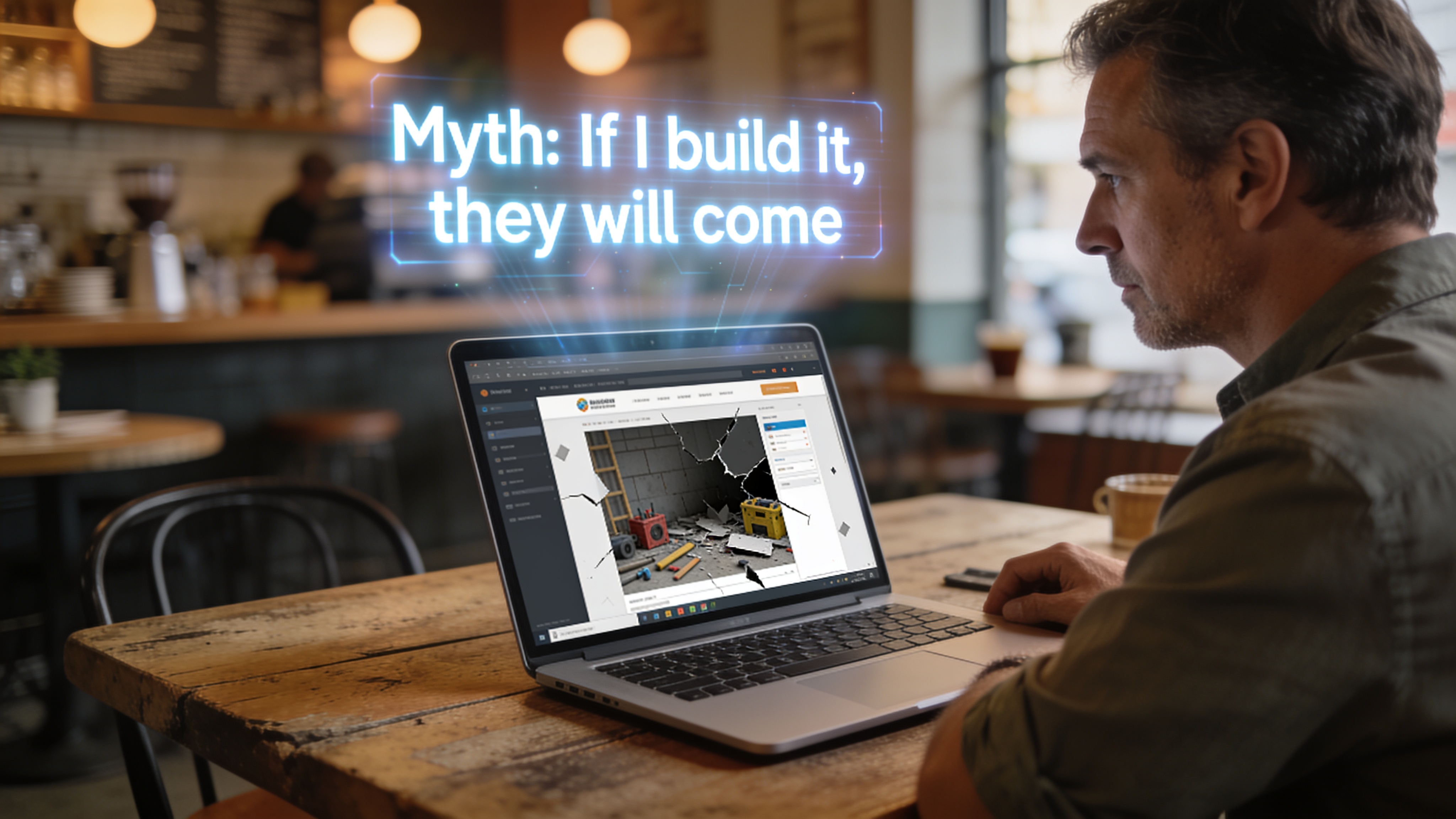
5 Common Misconceptions About Having a Website (and Why They're Costing You Customers)
81% of consumers research online before buying, and 98% use the internet to find local businesses. Those numbers make a strong case for having a business website. Yet many owners still believe a handful of common misconceptions about having a website that keep them invisible, or worse, leaving money on the table. These myths often sound reasonable, but they don't hold up under real-world data or the way people actually shop today.
Let's tear down five of the loudest ones, backed by recent stats, so you can make a clear-eyed decision about your online presence.
"Once It's Online, People Will Just Find Me"
Launch day feels like a finish line. You've picked the colors, written the copy, hit publish, and then you wait for the phone to ring. It rarely does. A website without a strategy behind it is like a shop on an unmarked dirt road with no sign.
Visibility depends on a chain of deliberate actions: search engine optimization (SEO), content that answers what your customers are typing into Google, fast load times, and a mobile-friendly design that does not frustrate half your traffic. Without these, your site literally does not exist to the algorithms that send visitors your way. WebFX notes that 75% of users never scroll past the first page of search results. If your pages are not optimized to get there, being "live" is just a technicality.
Think of your site as a tool, not a destination. It needs fuel: regular content updates, targeted keywords, and performance monitoring. Even a simple blog post every two weeks can signal to search engines that you are active and worth ranking. NextCore's Website Optimization service starts with a full audit that identifies exactly why a site sits invisible and then fixes those gaps layer by layer. It is not magic; it is method.
"Only Big or Online Companies Actually Need a Site"
This myth convinces brick-and-mortar shops, local service providers, consultants, and artisans that a website is excess weight. The numbers disagree. When HostPapa surveyed consumers, they found that 62% would not use a business if they couldn't find it online, period. Another 15% treat the absence of a website as an automatic red flag. So before anyone even picks up the phone to call a plumber, visit a bakery, or book a coach, they are checking their phone. If there is nothing there, they simply choose the competitor whose information pops up in seconds.
A physical storefront captures foot traffic. A website captures intent. The two feed each other. Even a lightweight, five-page site with your location, hours, service list, and a few testimonials tells a potential customer that you are real, reachable, and serious. Without it, word-of-mouth hits a ceiling. Someone recommends you at a dinner party; the first thing the other person does afterward is search your name. That moment either turns into an email or evaporates. A custom-built small business website closes that loop.
"Social Media Is All I Need"
Social platforms feel like free real estate, and they have reach. The problem is, you do not own the land. Algorithms change overnight. Accounts get shadow-banned, hacked, or simply lose traction for reasons no user can control. Your follower list is not yours; it belongs to Instagram, LinkedIn, or TikTok. When their priorities shift, your audience can vanish.
A website flips that dynamic. It is your digital headquarters where you control the branding, the content, the conversion path, and most importantly, the data. You can track who visits, where they come from, and what makes them fill out a form. On social media, you are building someone else's network; on your own site, you are building an asset. That asset feeds your social media efforts too. A strong article on your site shared across channels gives followers a reason to leave the feed and land somewhere you can actually do business. Plus, social links can die. Websites persist. If you are serious about growth, you need both, but only one of them is your permanent home base.
"I'll Build It Once and Be Done"
This might be the most expensive misconception on the list. Websites are not furniture. They are living software. Plugins, themes, browsers, and security libraries all need updates. If you ignore them, you accumulate technical debt that eventually breaks something: a checkout page that stops working, a contact form that quietly drops messages, a hack that turns your domain into a spam dispenser.
Weblium's research on website maintenance myths found that a reactive "wait until it breaks" approach costs three to five times more over the long run than proactive upkeep. A small security patch today keeps a $1,500 emergency restoration off your plate next month. And it is not just about safety. Search engines reward sites that stay fast and error-free. Core Web Vitals, Google's performance benchmarks, directly affect rankings. If your pages start creeping upward in load time because of unoptimized images or stale cache settings, your organic traffic can slide without any obvious warning.
For business owners who can't (or shouldn't) spend their evenings chasing update notifications, a Website Maintenance plan that runs daily checks for speed, security, and broken links is a fraction of what a single crisis costs. It keeps you off the reactive treadmill entirely. As we've written before, hiring someone to manage your website can transform the way you think about your online presence, from anxiety to background hum.
"DIY Tools Make Professional Websites Unnecessary"
DIY website builders have come a long way. They offer templates, drag-and-drop editors, and built-in hosting at a low entry price. For a hobby blog or a temporary event page, that can work just fine. For a business that relies on turning visitors into paying customers, the cracks start to show fast.
A Forrester/Forbes survey captured that small businesses with professionally built websites see revenue growth 15.3% faster in their formative years compared to those that go the DIY route. Why? Because DIY sites frequently ship with generic mobile layouts, sluggish performance from bloated template code, unclear calls-to-action (CTAs), and SEO fundamentals bolted on as an afterthought. Fixing these gaps later burns the very time the business owner was trying to save. One owner we worked with spent four months tinkering with a drag-and-drop layout, only to discover that the site loaded in 8 seconds on mobile and had no proper heading structure. They had traded hundreds of hours for a few hundred euros of initial savings.
A professional process does not just make things pretty. It builds around a specific business goal. That means responsive, mobile-first design that performs identically on a smartphone and a laptop, clean code that loads fast, a structure that search engines can read without confusion, and a clear path from landing to conversion. The cost difference shrinks dramatically when you factor in the revenue lost during months of a slow, hard-to-find site. If you want to see what a structured approach looks like, our Custom Web Design process moves from discovery to launch with audits built in, not bolted on.
Myths Cost More Than a Website
Each of these misconceptions shares the same root: they reduce a website to a checkbox instead of treating it as an operational tool. The data is unambiguous. Consumers expect you to have a functional online home. They penalize its absence, reward quality, and walk away when things break. The 27% of small businesses that still do not have a website cite reasons like "too small" or "not relevant to my industry" or "too expensive." Those reasons collapse under even basic scrutiny.
If you are still on the fence, audit your own assumptions. Ask whether your current setup, or lack of one, is costing you the 80% of potential customers who start their buying journey online. If the answer makes you uncomfortable, it is time to act, not because of pressure, but because the gap between you and a competitor with a fast, well-maintained site is widening every quarter.
A reliable hosting and maintenance package removes the ongoing burden, while a one-time optimization pass can bring a neglected site roaring back to life. There is no need to wrestle with updates, speed tests, or SEO blind spots alone. The path forward is simpler than the myths make it sound.
Ready to Start Your Project?
Let's build something amazing together. Get in touch to discuss your next project.
Contact Us Today